

What Is Needed For Growth And Repair
Os Development & Growth
The terms osteogenesis and ossification are frequently used synonymously to indicate the process of bone formation. Parts of the skeleton form during the starting time few weeks after conception. By the end of the eighth week after conception, the skeletal pattern is formed in cartilage and connective tissue membranes and ossification begins.
Bone development continues throughout adulthood. Fifty-fifty after adult stature is attained, bone development continues for repair of fractures and for remodeling to meet changing lifestyles. Osteoblasts, osteocytes and osteoclasts are the iii jail cell types involved in the development, growth and remodeling of bones. Osteoblasts are bone-forming cells, osteocytes are mature os cells and osteoclasts break down and reabsorb bone.
There are 2 types of ossification: intramembranous and endochondral.
Intramembranous
Intramembranous ossification involves the replacement of sheet-like connective tissue membranes with bony tissue. Bones formed in this style are called intramembranous bones. They include certain flat bones of the skull and some of the irregular bones. The future bones are beginning formed as connective tissue membranes. Osteoblasts migrate to the membranes and deposit bony matrix effectually themselves. When the osteoblasts are surrounded past matrix they are called osteocytes.
Endochondral Ossification
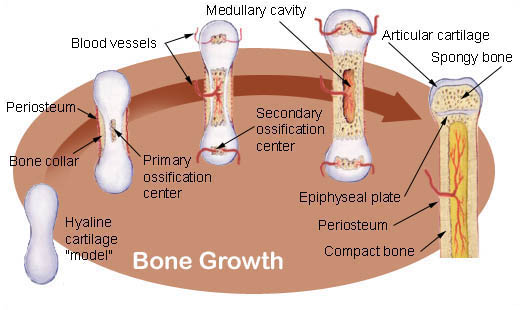
Endochondral ossification involves the replacement of hyaline cartilage with bony tissue. Most of the bones of the skeleton are formed in this manner. These basic are called endochondral bones. In this process, the time to come bones are first formed as hyaline cartilage models. During the third calendar month later conception, the perichondrium that surrounds the hyaline cartilage "models" becomes infiltrated with blood vessels and osteoblasts and changes into a periosteum. The osteoblasts form a neckband of compact bone around the diaphysis. At the same time, the cartilage in the center of the diaphysis begins to disintegrate. Osteoblasts penetrate the disintegrating cartilage and replace it with spongy bone. This forms a primary ossification centre. Ossification continues from this centre toward the ends of the basic. After spongy os is formed in the diaphysis, osteoclasts pause down the newly formed bone to open upward the medullary crenel.
The cartilage in the epiphyses continues to grow so the developing bone increases in length. Later, usually after birth, secondary ossification centers form in the epiphyses. Ossification in the epiphyses is similar to that in the diaphysis except that the spongy os is retained instead of existence cleaved down to form a medullary cavity. When secondary ossification is complete, the hyaline cartilage is totally replaced by bone except in two areas. A region of hyaline cartilage remains over the surface of the epiphysis as the articular cartilage and some other expanse of cartilage remains between the epiphysis and diaphysis. This is the epiphyseal plate or growth region.
Os Growth
Basic grow in length at the epiphyseal plate by a process that is similar to endochondral ossification. The cartilage in the region of the epiphyseal plate side by side to the epiphysis continues to grow by mitosis. The chondrocytes, in the region next to the diaphysis, age and degenerate. Osteoblasts move in and ossify the matrix to form os. This process continues throughout childhood and the adolescent years until the cartilage growth slows and finally stops. When cartilage growth ceases, commonly in the early twenties, the epiphyseal plate completely ossifies so that but a sparse epiphyseal line remains and the basic can no longer grow in length. Bone growth is under the influence of growth hormone from the inductive pituitary gland and sexual practice hormones from the ovaries and testes.
Fifty-fifty though bones stop growing in length in early on adulthood, they tin go on to increase in thickness or diameter throughout life in response to stress from increased musculus activity or to weight. The increment in diameter is called appositional growth. Osteoblasts in the periosteum course compact bone around the external bone surface. At the same time, osteoclasts in the endosteum interruption downwards bone on the internal bone surface, around the medullary cavity. These two processes together increase the diameter of the bone and, at the same fourth dimension, proceed the bone from becoming excessively heavy and bulky.

What Is Needed For Growth And Repair,
Source: https://training.seer.cancer.gov/anatomy/skeletal/growth.html
Posted by: dosswherfuld.blogspot.com
0 Response to "What Is Needed For Growth And Repair"
Post a Comment