

How Much Does It Cost To Repair Half A Mile Of Road In Michigan
Road funding in Michigan takes several forms. Federal funding comes from the Federal Highway Administration'due south Highway Trust Fund, which is funded past federal gasoline and diesel taxes. State funding typically comes from state fuel taxes, vehicle registration fees, income taxes and supplemental appropriations from the Legislature. Counties, cities and villages besides provide funding for their ain roads through road millages, general tax revenue and via special assessment districts. Public Act 51 of 1951, normally referred to as just "Act 51," governs how state revenue for roads and bridges is allocated and spent, with some of it defended for state roads and others shared with local governments for their use.[22]
Federal Road Funding
Federal road funding from the Highway Trust Fund comes primarily from the federal eighteen.4 cents-per-gallon gasoline taxation and 24.4 cents-per-gallon diesel taxation. Federal highway funds are bachelor for projects identified every bit federal-aid-eligible highways.[23] Federal funds provide an eighty percent match of local or state funding for eligible projects and cannot be used for routine maintenance.[24]
A common misperception is that Michigan is a "donor state" with regards to the federal Highway Trust Fund, pregnant taxpayers pay more than in federal fuel taxes than they receive in federal highway funding. According to data obtained by the Detroit Free Press in 2022, Michigan has not been a donor state since 2003. For example, Michigan paid $1.01 billion to the Highway Trust Fund in 2022 but received $one.05 billion from information technology.[25] Federal highway funding makes up a footling less than 30 per centum MDOT'south budget.[26] MDOT receives 75 percent of Michigan'south federal route funding, with county route commissions and cities and villages sharing the remaining 25 percent.[27]
Michigan Fuel Taxes and Vehicle Registration Fees
Acquirement from Michigan's 26.iii cents-per-gallon gasoline and diesel taxes and its vehicle registration fees brand up the bulk of the revenue that goes into the Michigan Transportation Fund. Money from the fund is then disbursed to MDOT, county road commissions and cities and villages. Vehicle registration fees contributed $1.2 billion to the MTF in 2022 while fuel taxes contributed $1.four billion. Vehicle championship fees contributed $xl 1000000.[28]
Michigan'south gasoline and diesel taxes were set at xix cents per gallon and 15 cents per gallon, respectively, in 1997 and not indexed for inflation. They were increased in 2022 to 26.3 cents per gallon and volition be indexed to inflation first in 2022. Vehicle registration fees were also increased past an boilerplate of 20 percent in 2022.[29]
The state too assesses a half-dozen percent sales tax on fuel purchases, but nearly all of that revenue is defended to public schools and local governments.[30] Electric vehicles are assessed a $100 annual surcharge and hybrid vehicles are assessed a $30 annual surcharge to start the fact that owners of these vehicles either do not pay fuel taxes or pay substantially less than owners of conventional vehicles do.[31]
Gasoline taxes for passenger cars are collected at the pump. Diesel taxes for interstate trucks operates much differently. Interstate trucks are covered past the International Fuel Tax Agreement, which provides a method for truck drivers to pay the appropriate corporeality of fuel taxes based on how many miles they drive in each jurisdiction. Truck drivers maintain a logbook that records the number of miles traveled in Michigan, calculate the diesel fuel that was required to travel those miles, and then pay the Michigan diesel fuel tax on that amount of fuel, plus the half-dozen percent sales revenue enhancement.[32]
The registration fees for passenger cars are based on the vehicle'due south age and estimated base price.[33] Registration fees for commercial trucks are based on the truck'south gross vehicle weight and range from $590 per twelvemonth for trucks weighing 24,000 pounds to $3,741 per year for trucks weighing over 160,000 pounds.[34]
There are exceptions, however. Trucks used every bit moving vans or to operate a carnival get a special registration rate that is fourscore per centum of the usual rate.[35] Information technology is unclear how much this reduces revenue to the MTF. Trucks that carry farm commodities, milk and logs also pay a essentially reduced registration fee that is not based on gross vehicle weight just instead is equal to 74 cents per 100 pounds of the weight of the tractor or empty truck.[36] This reduces MTF revenues past an estimated $twoscore million per year.[37] Approximately one-third of commercial trucks registered in Michigan pay this reduced registration fee.[*]
The almanac registration fee paid by farm, milk and logging trucks is often less than that for a typical rider auto. In December 2022, subcontract trucks paid an boilerplate annual registration fee of $72.21, milk trucks paid $129.80 and logging trucks paid $107.30.[38] The cost of a typical rider machine's registration fee was approximately $120.[39]
At that place is a widespread conventionalities that Michigan'due south weight restriction laws for commercial trucks are more generous than those in other states and this is largely responsible for the poor condition of Michigan's roads. Most states employ a truck'southward "gross vehicle weight" to determine the maximum allowable weight on the road. A 1982 federal law limits GVW on federal-help eligible roads to lxxx,000 pounds for an 18-bike truck. Michigan instead uses axle load restrictions, which set the maximum commanded weight on a single axel. This allows for trucks weighing in backlog of fourscore,000 pounds on Michigan roads, with a maximum of 164,000 pounds spread over 11 axles. Michigan'southward weight restrictions are grandfathered in under the 1982 law. If Michigan repealed them, it could not reinstate them and would have to operate under the federal limits.[40]
According to MDOT, pavement research shows that a single heavy truck does less pavement damage than two lighter trucks conveying the same combined load. This is, in part, considering the weight-per-axle tin be less for a single truck pulling two trailers compared to that of two lighter trucks each pulling a single trailer. MDOT also argues that repealing Michigan's police would add 10,000 to 15,000 trucks on the road, resulting in increased traffic and business costs.[41] Nonetheless, how Michigan's weight limits are set is less important than the question of whether the taxes and fees trucks pay is in line with the damage they exercise to Michigan's roads. As shown subsequently in this study, the fuel taxes and registration fees trucks pay are less than the estimated cost of the pavement damage they inflict.
How Michigan Transportation Fund Revenue is Distributed
Several government units, both land and local, receive money from the Michigan Transportation Fund, including the Michigan Department of Transportation, county road commissions, cities, villages and townships.
Michigan Department of Transportation
Michigan vehicle registration fees and fuel taxes generated approximately $ii.half dozen billion in revenue in financial year 2022. Approximately $24 one thousand thousand of this was used for authoritative overhead, with the biggest component beingness $twenty meg used to operate the Secretary of Land. A total of $63 million in transportation revenues went to the Economical Development Fund and the Recreation Improvement Fund. Another $154 one thousand thousand was spent on administrative grants, debt service and other grant programs. After these deductions, approximately $2.three billion in acquirement was distributed to MDOT, canton road commissions, and cities and villages to maintain and repair roads and bridges.[42]
The Economic Development Fund was created in Act 51 to fund transportation improvements that support individual investment and job creation. Its annual study cites 5 categories of road improvement projects eligible for assistance: for targeted industry development and redevelopment, to reduce urban traffic congestion, to create an all-season route network in rural counties, to support the development of commercial forests, and to support an all-season road network in urban areas of rural counties.[43]
Approximately $41 one thousand thousand in MTF revenues went to the Economic Development fund in fiscal yr 2022.[44]
Two percent of gas tax acquirement go to the DNR'due south Recreation Improvement Fund, representing fuel taxes paid past off-route vehicles and motor boats.[45] The Recreation Improvement Fund, in combination with the Michigan State Waterway Fund, helps fund the operation, maintenance and development of recreation trails, state restoration, inland lake cleanup and harbor and dock infrastructure.[†]
Some other 10 percent of the MTF is earmarked for the Comprehensive Transportation Fund. Money from that fund is used to back up public transportation throughout the state. Most of this money is allocated, based on a formula, to local transit agencies. In fiscal 2022, close to $250 million was disbursed from the MTF for such purposes.[46]
The $2.three billion remaining in the MTF after the monies described above were allocated were disbursed based on the following allocations: 39.one per centum goes to MDOT for the state trunkline fund, 39.1 percent goes to county road commissions and 21.8 percent goes to cities and villages.[47] One percent of the Act 51 distribution to canton road commissions is set aside for snow removal in counties that receive more than 80 inches of snow annually.[48]
County Road Commissions
Act 51 distributes MTF funds to county route commissions based on a number of factors. How much each county receives depends on how many miles of certain types of roads it has, how many vehicles are registered there, its population and its annual snowfall.[49] Graphic 11 summarizes these factors.
Graphic 11: MTF Distribution to County Route Commissions
| Criterion | Per centum of MTF Distribution | Factor |
| Principal Road Mileage | 6.4% | $2,164 per mile |
| Local Road Mileage | 16.4% | $2,374 per mile |
| Urban Route Mileage | nine.nine% | $12,390 per mile for urban primary roads, $2,065 per mile for urban local roads |
| Vehicle Registrations | 47.9% | 37ȼ per dollar collected in the county |
| one/83rd Share to Each County for Primary Roads | nine.6% | $1,056,287 per county |
| Rural Population | viii.8% | $16.88 per person |
| Snowfall Removal | ane% | Based on boilerplate wintertime maintenance costs and actual snowfall |
| Total | 100% | $906,168,948 to counties |
Source: Michigan Department of Transportation. Information from July 2022.
As seen from Graphic 11, the number of vehicle registrations inside a particular county is the largest determinant of how many MTF dollars a canton receives. If a canton has, say, 5 percent of all vehicle registrations in the land, then the county volition receive five percent of MTF dollars that are distributed based on vehicle registrations.
Each month, MDOT releases a set up of distribution factors that allows a county to determine the amount of MTF dollars it volition receive based on its population and road mileage.[l] The factors are found by taking the total amount of MTF dollars available for a particular category and dividing that sum by the county's population or number of road miles in that category. For example, total MTF dollars bachelor for primary county roads is divided by the total miles of master county roads to go far at $2,164 per mile. County route commissions would then multiply the number of chief county roads in their corresponding counties by $2,164 to make up one's mind their MTF allocation for primary road miles. The road commissions would make a similar calculation for each row in Graphic 11 to determine their full MTF distribution for the year.
The most recent allocation factors are given in the final column in Graphic 11. Each county receives $1,056,287 from the MTF plus 37 cents for every $1 residents in the county paid in vehicle registration fees. Rural areas, divers equally areas outside of an incorporated municipality, receive an additional $sixteen.88 per resident. Counties with urban roads receive $12,390 per mile for urban primary roads and $two,065 per mile for urban local roads. All counties receive $two,164 per mile for principal roads and $ii,374 per mile for local roads.[51]
It is not articulate whether urban counties or rural counties disproportionately benefit from how MTF funds are distributed. On one mitt, urban counties have more drivers, which amounts to doing more than harm to the roads. On the other hand, rural counties have a large number of roads relative to their population, and information technology would exist more difficult to maintain these roads if MTF dollars were distributed based strictly on population.
Graphic 12 illustrates this tradeoff. Counties are grouped into urban and rural counties based on U.S. Census information. Urban counties receive, on boilerplate, almost 5 times more MTF dollars than rural counties. Notwithstanding on a per capita basis, rural counties receive 57 percentage more than MTF dollars than urban counties. Rural counties have three times more miles of road per capita than urban counties. Thus there is a tradeoff in allocating MTF dollars on a population basis, which would benefit urban counties, and a miles of roads basis, which would benefit rural counties. The current MTF distribution formula tries to strike a balance between this tradeoff.
Graphic 12: MTF Distributions for Urban and Rural Counties, 2022
| Urban | Rural | |
| Average MTF Distribution | $23,029,055.57 | $four,890,398.72 |
| Boilerplate Population | 149,609 | 24,598 |
| Distribution Per Capita | $147.35 | $257.53 |
| Average Miles of Roads | 2,136.24 | 984.78 |
| Miles of Roads Per Capita | 0.0143 | 0.0400 |
Source: Writer's calculations based on data from July 2022 MDOT reports and data from the U.Southward. Census.
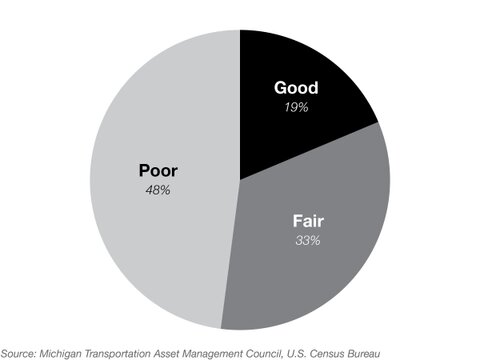
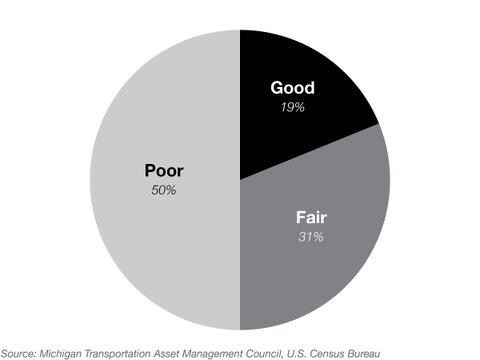
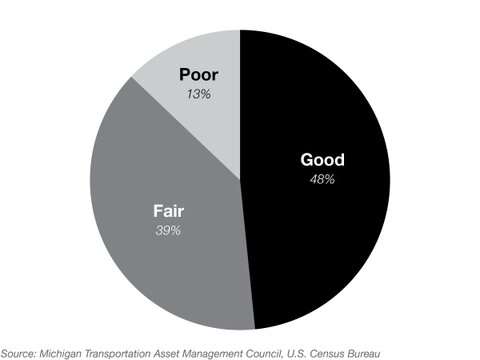
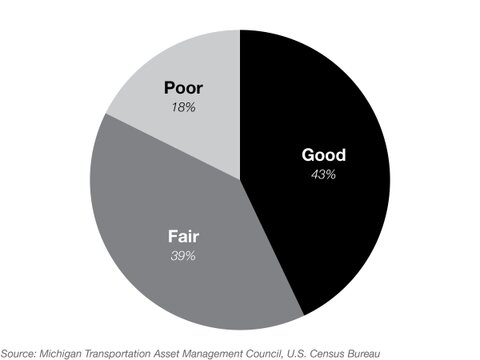
Graphics 13-sixteen illustrate average road and span conditions for urban versus rural counties. They testify that there is essentially no departure in boilerplate route weather in urban versus rural counties. And there are merely minimal differences in the boilerplate condition of bridges. This suggests that Act 51 might be striking the right residuum in allocating MTF dollars.
Graphic 13: Average Route Conditions in Rural Counties, 2022
Graphic 14: Boilerplate Road Conditions in Urban Counties, 2022
Graphic xv: Average Bridge Weather condition in Rural Counties, 2022
Graphic xvi: Average Bridge Condition in Urban Counties, 2022
Cities and Villages
Seventy-five percentage of MTF funds distributed to cities and villages are used for major streets and 25 percent are used for local streets. Threescore percent of the major and local street distribution is based on population and twoscore percent is based on route miles.[52] The MTF funds used for local streets must be matched by the municipality.[53]
Every bit it does with counties, each twelvemonth MDOT uses allotment factors to distribute MTF revenue to cities and villages. The distribution is based on population (equally of the latest U.Due south. Census) and road miles.[54] Unlike counties, cities and villages with a larger population get a larger per capita allotment from the MTF. That is considering the number of miles of major streets in a city or hamlet is multiplied past a population factor to determine the MTF distribution. This population factor increases with the city or village'south population. Graphics 17 and eighteen, which use data from Plante Moran's "Estimated Human activity 51 Revenue Worksheet" for the financial year ending June 30, 2022, illustrates the range of the factor:[55]
Graphic 17: MTF Distribution to Cities and Villages
| Major Streets | ||
| Criterion | Corporeality | Factor |
| Population | $43.96 per person | n/a |
| Major Street Mileage | $12,660.75 per mile | Encounter Graphic 18 |
| Trunkline Mileage | two x $12,660.75 per mile | Run into Graphic 18 |
| Local Streets | ||
| Population | $14.65 per person | n/a |
| Local Street Mileage | $3,335.25 per mile | n/a |
Graphic 18: Population Factors
| Population | Factor | |
| From | To | |
| 1 | ii,000 | 1.0 |
| 2,001 | x,000 | 1.1 |
| 20,001 | 30,000 | 1.two |
| 30,001 | 40,000 | 1.3 |
| 40,001 | 50,000 | one.4 |
| 50,001 | threescore,000 | i.v |
| 60,001 | 70,000 | 1.half dozen |
| 70,001 | 80,000 | 1.7 |
| eighty,001 | 95,000 | one.8 |
| 95,001 | 160,000 | ane.ix |
| 160,001 | 320,000 | ii.0 |
| Over 320,000 | Come across below | |
Note: For a population over 320,000, a factor of two.one is used plus an additional factor of 0.i for every 160,000 of population over 320,000
A city or village receives $43.96 per person for major streets and $xiv.65 per person for local streets. It also receives $3,335.26 per mile of local streets. In that location are a couple of things to note almost how major street mileage funds are distributed. First, the amount per mile increases every bit the municipality's population increases. A municipality receives $12,660.75 per major street mile times its population gene. Thus a city or village with 1,000 residents would receive $12,660.75 x ane.0 or $12,660.75 per major street mile. A city or village with 100,000 residents would receive $12,660.75 x 1.9 or $24,055.4 per major street mile. Michigan'due south largest city, Detroit, with a population of 713,777 in the 2010 census would receive $12,660.75 10 2.3 or $29,119.70 per major street mile. Thus, major street mileage funds are skewed toward large cities.
Second, some cities also get funding for trunkline miles. This funding allocation, bachelor to cities with over 25,000 residents, is based on a formula: the city's population factor multiplied by the number of trunkline miles within it. This allocation heavily favors Detroit, which has 22 percent of all trunkline miles in the state that run through cities with a population of 25,000 or more.[‡] Since Detroit'southward population factor is two.3, this trunkline mileage distribution nets the urban center an additional $17 million per year.
There is no clear reason why this distribution for trunkline mileage exists. As the Business firm Fiscal Bureau points out, maintaining trunklines within municipal boundaries is the responsibility of MDOT, not the municipality.[56] Cities and villages with a population over 25,000 practice accept to contribute funds toward trunkline improvements, just their contribution is modest. Cities with a population over 50,000 have to pay 12.5 percentage of the project's cost, cities with a population between 40,000 and fifty,000 pay 11.25 percent, and cities with a population between 25,000 and 40,000 pay 8.75 percent of the cost.[57] Limited access highways, such every bit interstate highways, are exempt from this toll sharing requirement.[58] This exemptions benefits cities such as Detroit, given the numerous miles of express access highways that run through it.
In addition to these issues, the per-mile trunkline distribution is double what is allocated for major street maintenance and repair, which cities are responsible for maintaining. Approximately $61.five meg was distributed to cities for trunkline maintenance in 2022, fifty-fifty though cities are non responsible for maintaining these roads.[§]
In short, distributions from the Michigan Transportation Fund to cities and villages function in a similar way to counties in that the distribution is based on population and road mileage. Multiplying major route mileage by a population cistron and giving municipalities with a population over 25,000 an allotment based on trunkline miles (which is also multiplied by the population cistron) skews the distribution toward larger cities. Money distributed to counties is not, by contrast, skewed this way.
Counties, cities and villages take some flexibility in how they spend MTF dollars. With some exceptions, they can transfer some of their earmarked funding for other purposes. For case, counties tin can divert up to 30 percent of their funding earmarked for primary roads to local roads, if they choose. Conversely, they tin shift 15 percent of their funding earmarked for local roads to maintaining and constructing primary roads. They can spend another xv percentage of local road funding on primary roads, in the case of an emergency or with the specific approval from MDOT.[59] Cities and villages tin as well employ MTF funding earmarked for major streets on local streets, provided that the work is for maintenance and not construction and that it does not exceed 50 percent of the municipality'south major street funding, unless it adopts an asset management procedure and sends a copy of the plan to MDOT.[sixty]
Local Road Millages
Some counties, townships, cities and villages supplement their MTF distribution with local holding taxation levies. Graphic 19 gives information on these local route millages, based on data from 2022.
Graphic 19: Local Route Millages
| Unit of Government | Number With Route Millage | Total Units of Government | Percent with Road Millage | Boilerplate Millage Rate |
| County | 27 | 83 | 33% | 1.2298 mils |
| Township | 472 | 1240 | 38% | 1.7248 mils |
| City/Village | 150 | 533 | 28% | ii.7235 mils |
Source: Michigan Section of Treasury
A mill is a $ane tax per $1,000 of assessed taxable value, which is approximately equal to one-one-half of the sale price of the property. A homeowner with a $200,000 house in a urban center levying a 2.7235 millage would owe a $272.35 belongings tax toward the city'southward roads. Information technology's difficult to determine the touch on these local millages have local governments' ability to maintain their roads, as they depend heavily on the millage rate and the local property value in the jurisdiction. They could, nonetheless, be a significant source of road funding for some municipalities.
There is some testify that road millages amend road quality for cities and villages. However, it is hard to determine the relationship betwixt the road conditions and road millages in a county because both counties and townships tin can levy millages, but PASER data is but available at the county level. With this limited information, it would be impossible to know if an private township'due south route status was improved by its millage.
Since cities and villages are responsible for maintaining certain roads and PASER data exists at the metropolis and hamlet level, it is possible to calculate a correlation between municipal millages and route conditions. For cities, at that place is a strong correlation betwixt the 2. Fifty-8 percentage of roads in cities without a road millage are in poor condition, on average. If a city has a road millage, each mill is correlated with a 6-betoken reduction in the percent of its roads that are in poor condition, a result that is statistically significant. In other words, a city with a i-mill road millage volition have 52 percent of its roads in poor status, on average, compared to 58 percent for a city with no road millage.
The correlation is weaker for villages. Forty-seven percent of roads in villages without road millages are in poor condition. Each mill of a road millage is only correlated with a iii-tenths of a point reduction in the percentage of roads in poor condition, a issue that is non statistically pregnant. I potential explanation for this is that villages accept smaller populations than cities and typically less taxable property value, and so a route millage in a village might not collect as much revenue every bit a route millage in a city, limiting the number of improvements the village tin undertake. A village might only need a substantially college millage charge per unit than a city to get the dollars needed to meliorate its average quality in a way that would make a significant deviation. The average road millage for villages is 3.3 mils, ane mill higher than the average rate for cities.
Special Assessment Districts
Neighborhood streets in a subdivision within a township are under the jurisdiction of the canton road commission. County road commissions typically maintain, repave and reconstruct these roads frequently, likely considering they requite priority to other, more-travelled roads nether their jurisdiction. Nevertheless, residents who wish to have these types of roads maintained tin can petition to create a "special assessment district" for the purpose of levying a revenue enhancement on property owners in a defined expanse. SAD taxes must increases the value of properties in the district.[61]
Residents in a proposed SAD must get fifty percentage of property owners to sign a petition for the SAD program to move forrad. In one case this happens, a public hearing is held for residents to express support for or opposition to creating a commune. If a bulk of the board of directors of the county road commission votes to create it, the work to be supported by the special assessment is bid-out and a second public hearing is held to talk over the required costs. If final approval is given by the board to authorize the work and assessment, the Deplorable is created and the cost shared amidst its residents.[62]
According to the Michigan Department of Treasury, only iii municipalities have SADs defended to road funding: the townships of Clarence, Porter and Lenox in Calhoun, Van Buren and Macomb counties, respectively. The vast majority of special cess districts used in the state are for fire services.[**]
MTF Revenue Trends
To summarize, nearly half of all county, city, and hamlet roads in Michigan are rated as being in poor condition, with over one-half of Michigan's trunkline roads projected to be in that state by 2024. How did Michigan's roads end upwardly in this condition?
The main trouble appears to be that MTF revenues take not kept up with aggrandizement, as shown by Graphic 20. Several years nigh the beginning of the century were especially difficult for the fund, with revenues falling even without adjusting for inflation.
Graphic twenty: Inflation-adapted MTF Revenue Distributions, 1997-2017
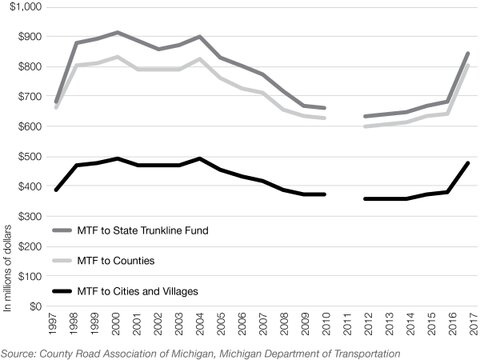
Before the fuel tax and vehicle registration fee increased in 2022, MTF revenue had fallen by 25 percent from its peak in 2000. Fifty-fifty with the tax and fee increase, MTF revenue nevertheless remains approximately $70 meg below that peak.
Complicating matters farther, the cost of maintaining and constructing roads steadily increased. In other words, the real purchasing power of the money regime officials have to spend on road maintenance declined substantially.
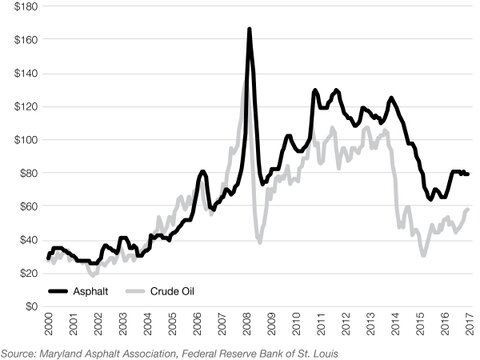
For case, the price of crude oil plays a substantial office in determining how far road dollars will go as it is an important ingredient in asphalt. Graphic 21 plots the monthly price of a barrel of W Texas Intermediate crude oil versus the monthly cost of a ton of liquid cobblestone. Since the price of a ton of asphalt is roughly v times that of a barrel of crude oil, dividing the price of asphalt past v makes the relationship between the 2 easier to run across. Note that the two lines appear to movement in tandem.
Graphic 21: Price of Rough Oil vs. Toll of Ton of Liquid Cobblestone
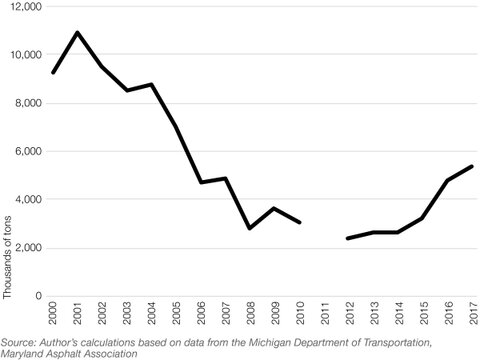
Graphic 22 illustrates how much asphalt could exist purchased if all MTF revenue was used only on asphalt. Obviously, MTF revenues are used for things other, also. This figure only shows how fuel taxation and vehicle registration fee revenue are non keeping up with the increasing price of asphalt. Between 2008 and 2022, MTF revenues were only able to buy, on average, less than 1-quarter the amount of asphalt as in the yr 2000. Even after the fuel revenue enhancement and vehicle registration fee increment in 2022, MTF revenues could just purchase one-half the asphalt they could in 2000.
This trouble is worsened by the fact that drivers might reply to higher crude oil prices — and increased gas prices — by driving less. Rising rough oil prices discourages drivers from spending on fuel, which reduces the state's tax revenue for roads. At the same time, the price increases in crude oil makes asphalt more than expensive. In other words, increases in crude oil prices harm road financing from both ends: they reduce revenues and make road work more than expensive.
Graphic 22: How Much Asphalt MTF Revenues Could Purchase, 2000-2017
Graphic 23 describes the problem in more item. Between 2000 and 2022, MTF revenues increased an average of 0.8 pct per year. During the same time period, aggrandizement (as measured by the consumer cost index) averaged 2.ane percent per year and crude oil prices increased by an average of five.5 pct per year. Asphalt prices increased past an boilerplate of seven.three per centum per year.[††] The table below too illustrates this trend for the years earlier the Great Recession. Betwixt 2000 and 2007, MTF revenues increased by an average of 1.1 percent per yr. Inflation averaged 2.seven percent growth annually, while crude oil and asphalt increased by a yearly boilerplate of 14.5 percent and 11.4 percentage, respectively. In short, MTF dollars failed to keep up with costs, which likely impacted the condition Michigan's roads are in now and projected to be in the about future.
Graphic 23: Purchasing power of MTF revenues, annual average change, 2000-2016
| Period | MTF Revenues | Aggrandizement | Crude Oil | Cobblestone |
| 2000-2007 | 1.one% | two.vii% | xiv.5% | 11.four% |
| 2000-2016 | 0.viii% | two.1% | 5.5% | seven.3% |
For much of 2001, the nation was in a recession, which the National Bureau of Economic Research estimates concluded in Nov of that year.[63] But while the rest of the nation recovered following this downturn, Michigan's economic system entered a "i-state recession" that lasted until 2007 when the country, along with the balance of the nation, entered the Keen Recession, which ran from Dec 2007 through June 2009.
Graphic 24 compares the performance of Michigan's economy with the national economic system between the end of the 2001 recession and the start of the Great Recession, as well as from the stop of the 2001 recession to 2022. From 2002 to 2007, the national economic system grew by an average of 2.7 percent annually, while Michigan's economy shrank by an average of 0.6 percent annually, as measured by gross domestic production. Per capita personal income shrank by an average of 0.iii percent annually in Michigan, while nationally it grew by an average of 1.2 per centum annually. The Michigan unemployment rate was as well, on average, 1.half dozen percentage points higher than the national unemployment charge per unit. Equally seen from Graphic 24, the national economy outperformed the Michigan economic system for the unabridged 2002-2017 time period.
The slowdown in the economy resulted in a slowdown in vehicle miles driven and thus a reduction in dollars going into the MTF. Nationwide, drivers traveled well-nigh 12 percent more miles in 2022 than in 2002.[64] In contrast, Michigan drivers traveled only 1 percent more miles over the same menstruation.[65] Thus Michigan'due south road funding experienced a double-whammy: tax revenue went downward fifty-fifty as the cost of maintaining roads went up.
Graphic 24: Michigan vs. National Economic system, 2002-2017
| Michigan | |||
| Period | Gdp Growth | Unemployment | Per Capita Personal Income Growth |
| 2002-2007 | -0.6% | half dozen.9% | -0.3% |
| 2002-2017 | 0.4% | vii.9% | 0.3% |
| National Average | |||
| Period | Gross domestic product Growth | Unemployment | Per Capita Personal Income Growth |
| 2002-2007 | ii.7% | five.3% | ane.two% |
| 2002-2017 | 1.8% | 6.3% | 1.0% |
[*] In December 2022, there were approximately 80,000 trucks registered who paid the full registration fee based on GVW and 47,000 registered farm, milk, and logging trucks that paid the discounted registration fee. See "Michigan's Truck-Weight Law and Truck-User Fees" (Michigan Department of Transportation), https://perma.cc/ 9EN7-U2QQ.
[†] The Waterway Fund receives 80 percent of the revenue generated from the 2 pct of gas tax acquirement that is devoted to the Recreation Improvement Fund. Another 14 percent of this revenue is dedicated to snowmobile trail construction and maintenance. "Where the Money Comes From" (Michigan Department of Natural Resources, 2022), https://perma.cc/3J7M-KYEZ; "Recreation Improvement Fund" (Michigan Department of Natural Resources, 2022), https://perma.cc/ VFT4-UU8L.
[‡] Equally of April 2022, at that place are 1,332.07 miles of trunkline roads running through Michigan cities with a population of 25,000 or more than. Detroit has 290.nine of these miles. "City/Village Population and Mileage: MTF Distribution Month: April, 2022" (Michigan Section of Transportation, May 22, 2022), https://perma.cc/8FKQ-9NJ9.
[§] Trunkline mileage funds are allocated based on two times the population factor, times the number of trunkline miles in the metropolis, times $12,660.75 per mile. "City/Village Allocation Factors" (Michigan Department of Transportation, 2022), https://perma.cc/U9PQ-PTWX.
[**] This data can exist found hither: https://eequal.bsasoftware.com/ MillageSearch.aspx.
[††] I utilise the time period 2000-2016 because 2022 is an outlier in that MTF revenues increase by 26 percent due to the increase in the gas taxation and vehicle registration fee. This pulls the average for the entire time period upwardly to a 2 percent increase, which gives a misleading picture about what was happening to MTF revenues during this time menstruum.

How Much Does It Cost To Repair Half A Mile Of Road In Michigan,
Source: https://www.mackinac.org/25863
Posted by: dosswherfuld.blogspot.com
0 Response to "How Much Does It Cost To Repair Half A Mile Of Road In Michigan"
Post a Comment